What should you check before a lease renewal?
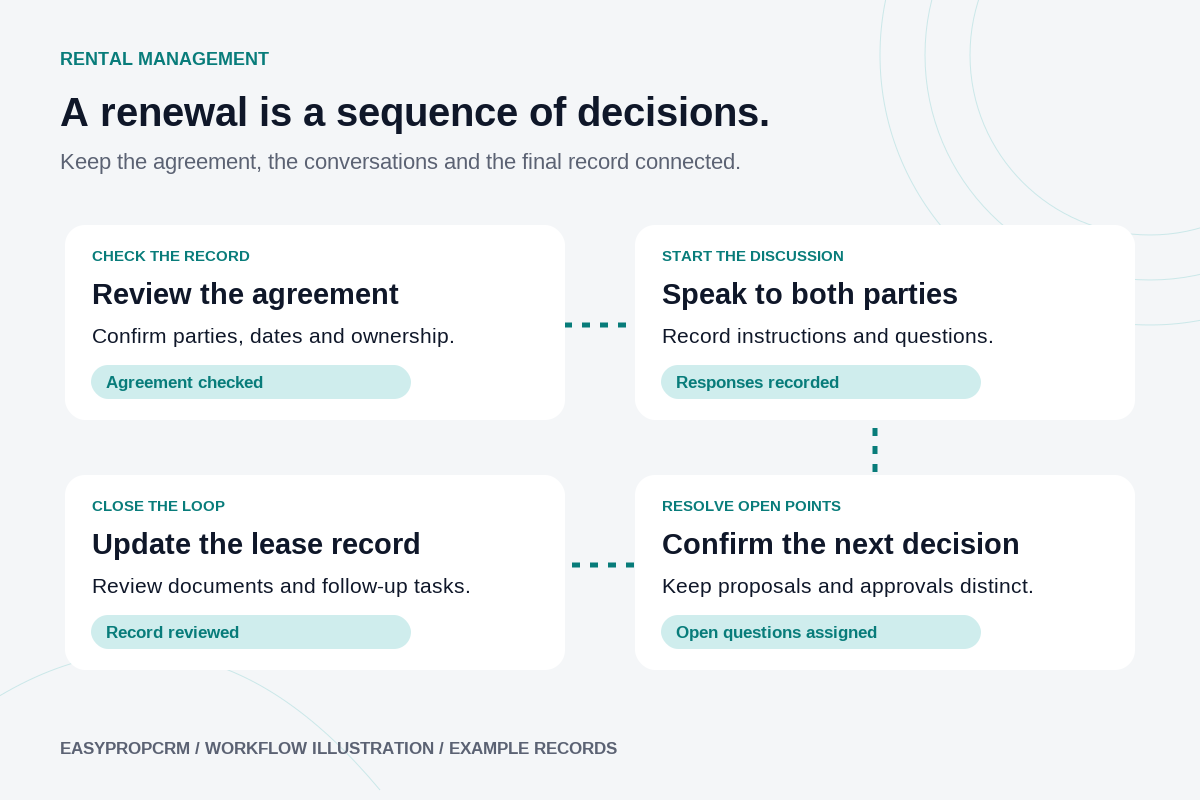
Begin with the current signed agreement and the record your team actually uses. Confirm the property, parties, lease end date, responsible agent and where the supporting documents are stored. If the CRM date differs from the agreement, resolve that discrepancy before sending reminders or discussing a new period. A calendar can reliably prompt action only when the underlying date is correct.
Review the requirements that apply to this tenancy and the agency’s responsibilities. A generic reminder schedule cannot determine the correct notice, contractual terms or legal process for every agreement. Get qualified guidance where the position is unclear. For the operational plan, write down which decisions are needed, who will obtain them and which dates have been checked. This gives the team a reliable basis for the conversations ahead.

Start with the agreement. Make room for the conversation.
How do you build a manageable renewal work list?
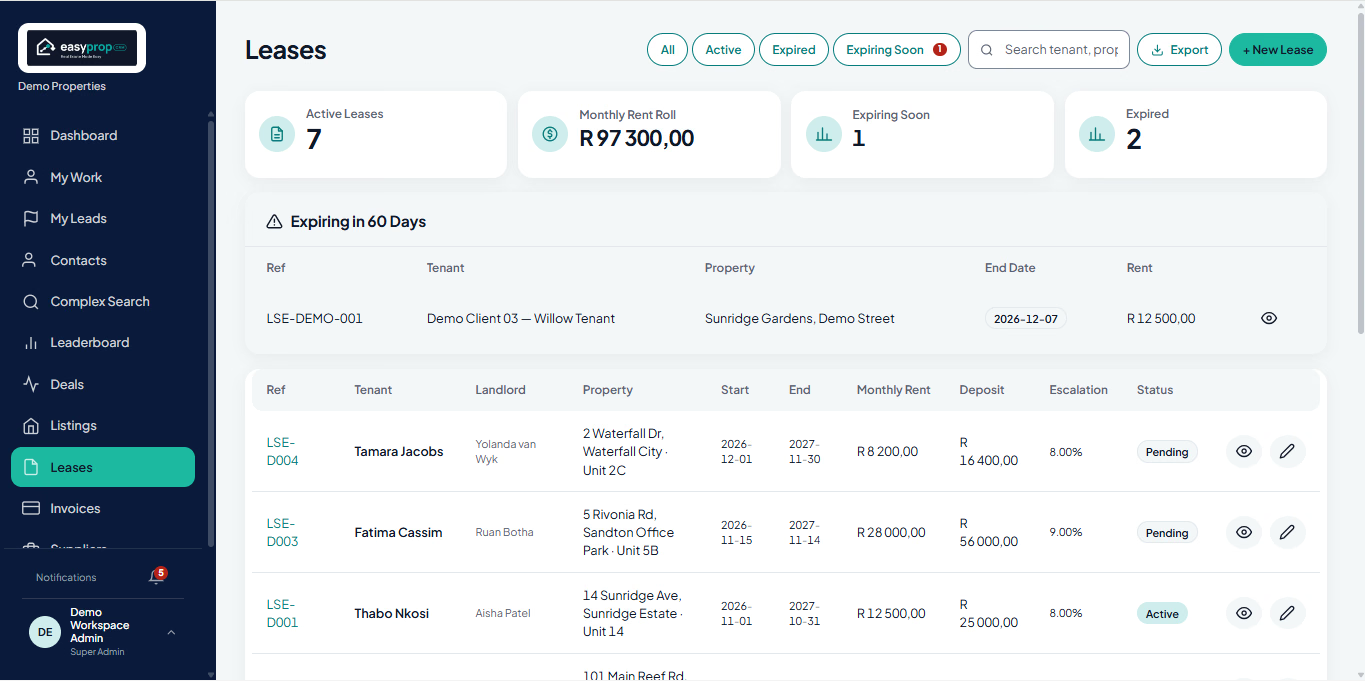
Create a working view of leases approaching their end dates and assign an owner to each review. The list should include the property, lease end date, next action, follow-up date and current decision status. Separate records that are ready for discussion from those missing essential information. Otherwise, an unresolved document problem can remain hidden behind a reassuring reminder on the calendar.
Choose an internal review window that leaves time for the steps your team needs to complete. Work backwards from confirmed dates to allow for checking records, contacting the parties, resolving proposals and preparing documents. The lease renewal planner can help organise dates, but its output is a planning aid. Review each result against the agreement and the circumstances rather than treating every tenancy as identical.
- Assign one person to coordinate the renewal review.
- Flag missing agreements or conflicting dates before outreach.
- Give every open renewal a next action and follow-up date.
What should you discuss with the landlord?
Ask what outcome the landlord wants and what information is needed to reach it. Relevant operational questions may include whether continued occupancy is intended, which proposed terms should be discussed, and whether outstanding repairs or other issues need attention. Record an instruction as an instruction, and a proposal as a proposal. A note that says ‘rent reviewed’ does not explain what may be communicated or what remains undecided.
Keep the reasoning and approvals with the record where the team can refer to them. If the landlord changes a proposal, record the new position and identify which earlier information is superseded. Before another team member contacts the tenant, they should be able to see the current authorised discussion points. This reduces contradictory messages and makes it easier to explain why the next step has changed.
What should you record after speaking to the tenant?
Record whether the tenant intends to continue, has questions or has not yet decided. Capture the actual response rather than interpreting silence as agreement. Note who spoke, when the conversation happened, which proposal was discussed and what was promised next. A short factual summary is more useful than a long transcript that hides the open decision among unrelated details.
Keep requests and concerns visible. For example, a tenant may want clarification on proposed dates or may raise a repair that needs a separate response. Assign each issue to the appropriate person instead of leaving it in a general renewal note. Confirm the next communication step and update the record when a response arrives. A reminder should point to a specific conversation, not simply repeat ‘follow up’ indefinitely.
- Response: continuing, not continuing, undecided or awaiting clarification.
- Open questions: each with a responsible person.
- Next contact: purpose, owner and planned date.
How do you keep proposals and agreed terms separate?
Use clear working statuses such as ‘review needed’, ‘discussion underway’, ‘awaiting decision’, ‘documents being prepared’ and ‘completed’. Adapt the wording to your agency’s process and the fields available in your CRM. Define what each status means so that an agent and a manager interpret it in the same way. ‘Renewed’ should have a clear evidence requirement in your internal process.
Keep a record of the current proposal and the decisions that support it. When a new document is prepared, check it against the approved position before it is sent through the agreed signing process. Save the final version in the appropriate place and make clear which earlier drafts are no longer current. Scheduling a reminder or recording a verbal intention does not by itself complete the renewal workflow.
Try the renewal planner with a real screenshot guide
Use the free planner to turn one lease end date into three internal review prompts. This example uses 30 June 2027; use the verified end date for your own lease.
Open the lease renewal plannerSelect the Lease end date field
Click the date field or its calendar icon. Choose 30 June 2027 for this example. Your browser may display the date as year/month/day or in another local format.
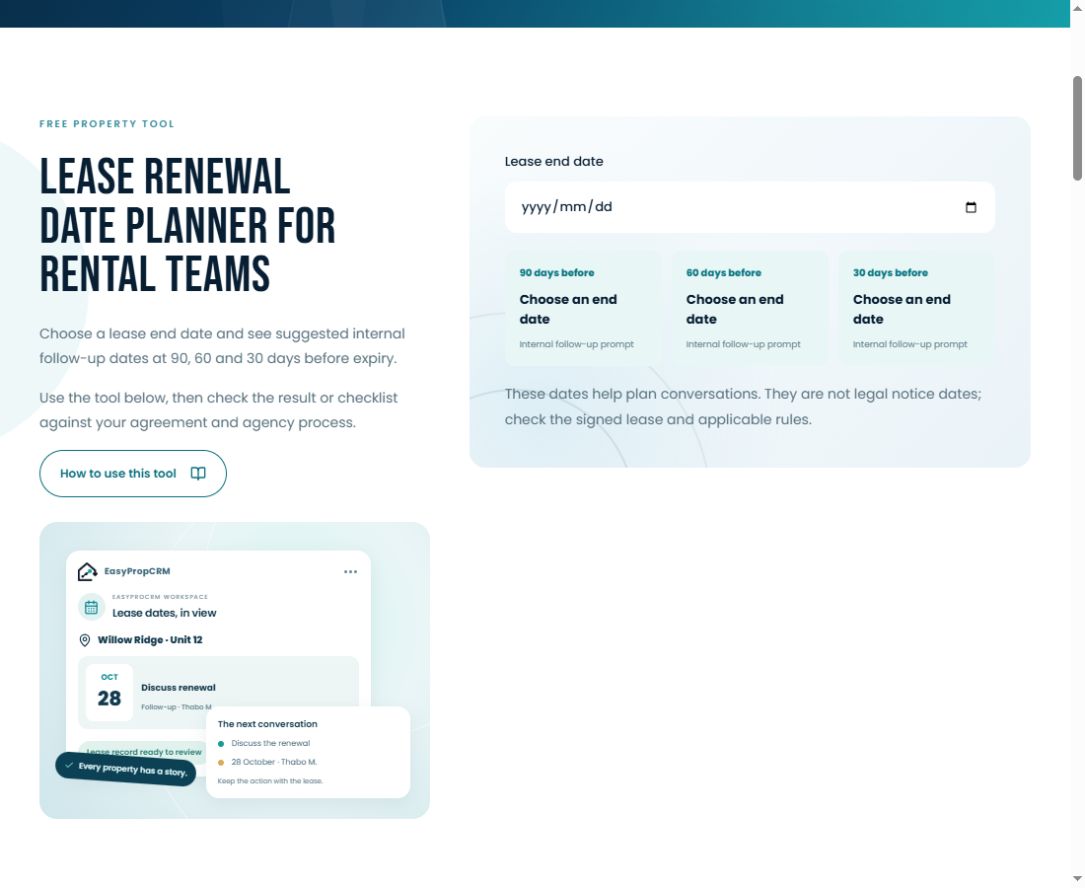
Read the three calculated follow-up dates
After selecting the date, the 90-, 60- and 30-day results update automatically. There is no Calculate button. Read each date under its matching interval.
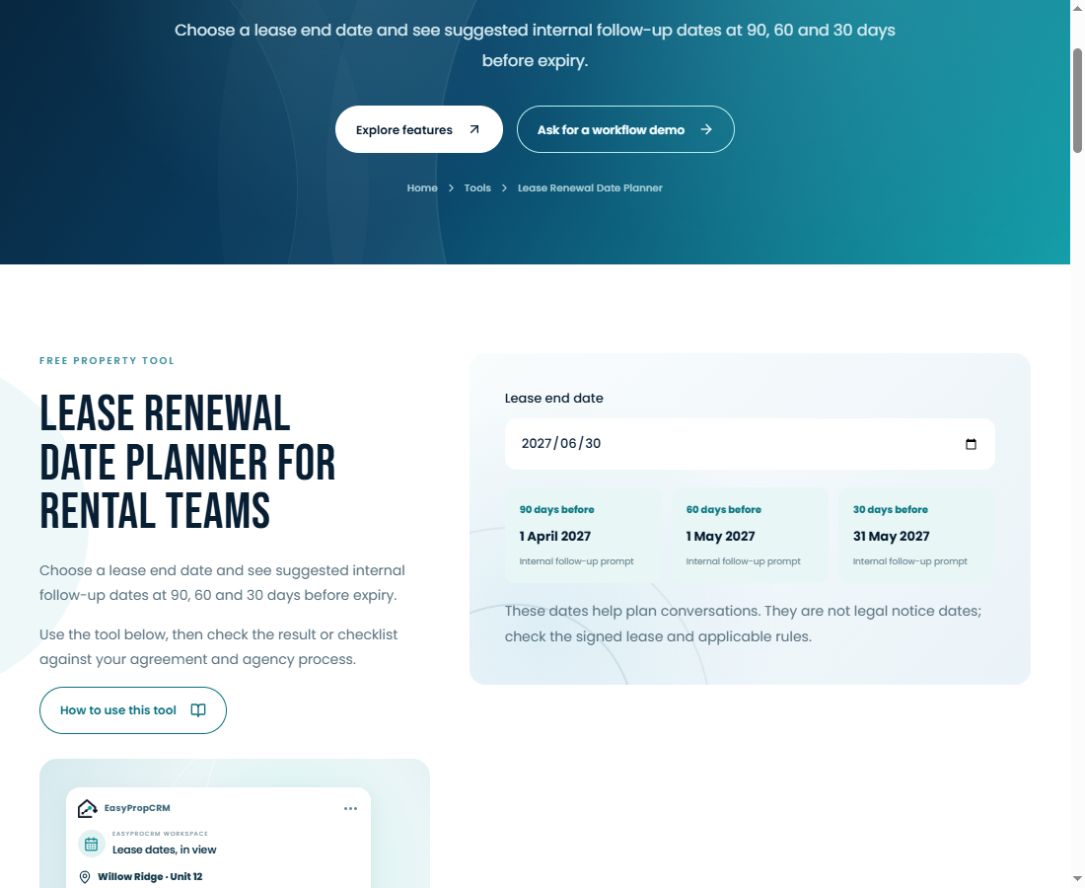
For 30 June 2027, the results are 1 April, 1 May and 31 May 2027. Copy the relevant prompts into your own task or calendar system and assign an owner. These are internal planning offsets, not legal notice deadlines. The public planner does not save dates or create reminders.
Screenshots: EasyPropCRM public tools · Captured 27 October 2026 · Example inputs.
What if a renewal decision is delayed?
Give the record a visible exception status and explain the reason. ‘Awaiting landlord instruction’ and ‘tenant requested clarification’ are different problems and need different actions. The responsible agent should know when to follow up, what to ask and when to escalate to the person overseeing the matter. Do not allow the work to disappear because a planned call did not produce a decision.
Keep the communication history factual and accessible to the authorised team. Avoid assuming that an unanswered message or a missed internal deadline determines the legal position. Review the agreement and obtain suitable advice when the circumstances require it. Operationally, the goal is to make the uncertainty visible early enough for the right person to handle it, with the relevant record and history available.
What changes after the renewal is completed?
Check the final documentation and update the lease record through your agency’s approved process. Confirm the new dates, agreed details and relevant follow-up tasks. Review connected billing or administrative work separately so that a change in the lease record is not assumed to have updated every downstream task automatically. Keep the source of each change clear for the colleagues responsible for that work.
Close obsolete reminders and schedule the next review from the verified record. During a team check, look for completed renewals still appearing as open, new terms without supporting documents, and old actions that no longer make sense. A clean handover into the next lease period helps the agency avoid repeating the same information-gathering exercise when the following review comes around.
Bring this checklist to your next team review.
- Have the agreement and relevant dates been verified?
- Are landlord instructions and tenant responses recorded separately?
- Does every open question have an owner and next action?
- Is the current document clearly distinguishable from earlier drafts?
- Have the lease record, reminders and related administrative tasks been reviewed?
Turn the idea into a working process.
Explore the relevant EasyPropCRM workflow or use a practical planning tool with your team.