 Log in
FICA document status tracking in your property CRM
Make document follow-ups easier to see and act on. EasyPropCRM helps your agency organise contact records and recorded FICA status as part of its own review process.
FICA tracking: the essentials for your property team
See which supporting information has been recorded and what still needs attention.
Keep compliance decisions with the agency’s authorised people and procedures.
- Track documents and outstanding actions.
- Treat recorded status as operational information.
- Apply the agency’s approved due-diligence process.
What does FICA tracking in EasyPropCRM cover?
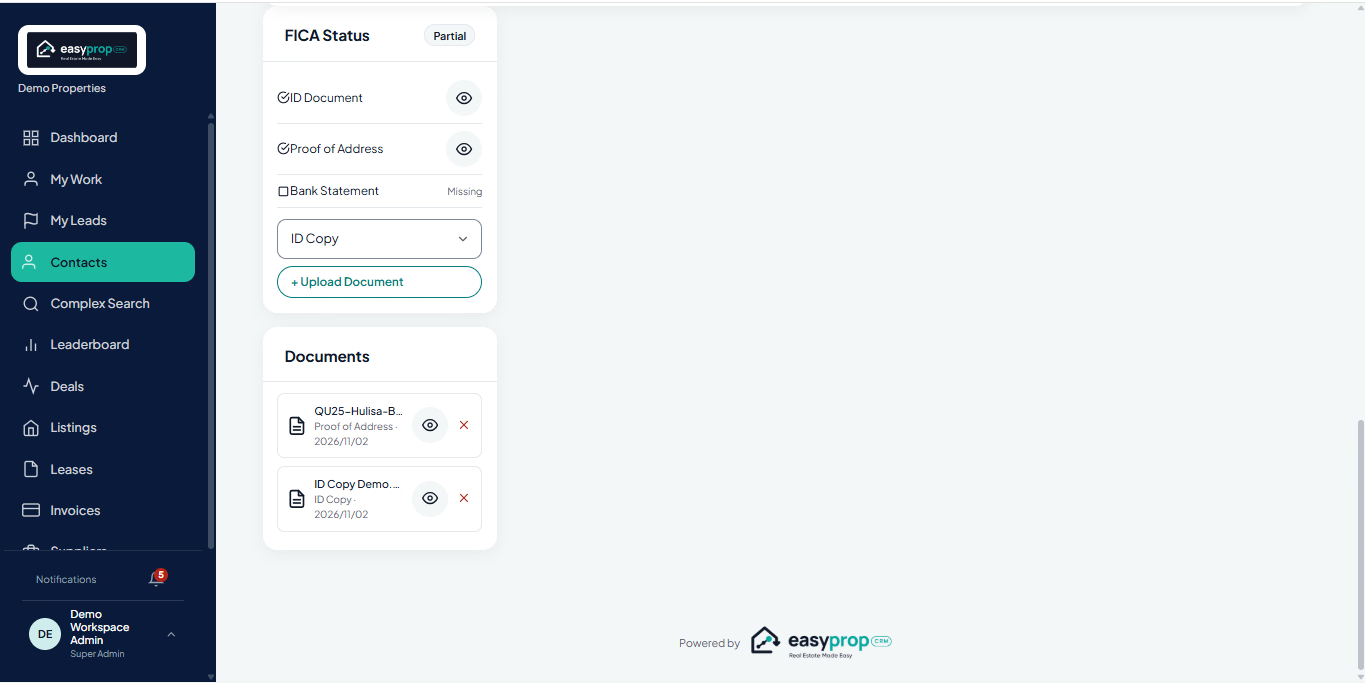
FICA tracking helps an agency organise documents associated with a contact and see the status recorded for its review process. The practical question is what information is available and what needs attention next. A colleague following up can begin with the relevant person and outstanding task instead of searching through disconnected messages.
The scope is document and status tracking. A CRM badge does not independently verify identity, establish the authenticity of a file or certify legal compliance. EasyPropCRM supports the organisation of work; the agency’s authorised reviewer decides what the information means under the procedures that apply to the particular client and transaction.
Why is document tracking only part of FICA work?
The Financial Intelligence Centre describes a risk-based framework that includes customer due diligence, record keeping and other obligations. This is wider than collecting a fixed pair of documents or changing a contact status. The agency should use current official guidance and its approved risk management and compliance programme to determine the required process.
Keep the feature’s purpose clear when introducing it to staff. A missing-document task is something the team can organise and follow up; a regulatory decision requires the appropriate authority and evidence. Do not present a completed checklist as a universal certificate that every possible requirement has been met for every kind of client.
How should a contact’s FICA records be organised?
Confirm the person and role before reviewing or attaching supporting information. Check that the record belongs to the right contact and that the file is readable. Use a clear description that lets an authorised colleague understand the document’s purpose without placing unnecessary personal details in a filename or general note.
Follow the agency’s accepted collection and review process for the relevant client. Different circumstances may require different evidence; use the requirements that apply to the particular review. Where something is incomplete or unclear, record the specific follow-up required and the person responsible for resolving it. This keeps the operational task visible without overstating the review outcome.
How should the team interpret a recorded FICA status?
Agree what the statuses available in the current account mean within the agency’s process. Staff need to understand who can change them, what must be checked first and when an existing record should be reviewed again. Do not infer a legal conclusion from a familiar label without knowing the work behind it.
For example, receiving a file and accepting it after review are different events. If a colleague has only received information, the record should not imply that an authorised assessment has already happened. During training, use realistic incomplete and ambiguous examples so staff can practise recording an outstanding action rather than moving every contact towards the most reassuring label.
How do document follow-ups fit daily property work?
A follow-up should explain the missing or unclear item, the permitted way to request it and who will review the response. Use the contact context and a dated reminder where appropriate. Keep sensitive details out of a broadly visible task title when a simple reference to the outstanding review is enough.
When new information arrives, the responsible person should inspect it and update the working record according to the agency’s procedure. Completing a reminder only shows that the task was handled; it should not silently substitute for a separate review decision. This distinction helps administrators, agents and reviewers cooperate without confusing their responsibilities.
What should agencies check before using FICA tracking?
Nominate the person responsible for the review process and confirm how documents will be collected, accessed and retained. Test role behaviour using a sample with personal information removed. Check which fields and statuses the current account provides and explain their intended use to the team.
Use the free document tracker to organise a planning conversation, then demonstrate the actual contact and document workflow in EasyPropCRM. The planning tool is not a verification service. If the agency needs screening, identity verification or another specialist service, discuss that requirement separately and confirm the process rather than assuming document tracking includes it.
How does document follow-up fit the wider agency process?
A missing document can interrupt a property handover even when the contact and deal are already recorded. Keep the document request, responsible staff member and next follow-up clear so the team can see what still needs attention. FICA tracking gives the agency a place to organise recorded status alongside its property relationships.
During free setup and training, agree how staff will use the status fields and who reviews the records before the team relies on them. The CRM's daily backups and document organisation support record keeping, but a recorded status is not a legal compliance determination. Use your agency's own compliance process to decide what evidence is required and whether it is sufficient.
A practical FICA document follow-up workflow
Identify the correct contact
Confirm the person, role and relevant transaction context. Apply the agency’s process to establish what information needs to be reviewed.
Check what is recorded
Open the associated documents and recorded status. Inspect the actual files and note any incomplete, unreadable or uncertain information.
Assign the next action
Give the unresolved item an owner and a suitable follow-up date. Request information through the agency’s approved collection and communication method.
Record the authorised review
Have the responsible person assess the response and update the working record appropriately. Keep the distinction between document receipt, task completion and a compliance decision.
Understand what each tracking item tells you
| Tracking item | What it can show | What it does not establish |
|---|---|---|
| Attached file | Information has been recorded for the contact. | Authenticity or legal sufficiency. |
| Recorded status | The status entered under the agency’s process. | Independent identity verification. |
| Completed reminder | A follow-up task has been handled. | That every compliance obligation is complete. |
| Document checklist | Items the team is reviewing. | A universal requirement for every client. |
- Identify the authorised reviewer and escalation route.
- Confirm the current account’s status labels and their meaning.
- Use the agency’s approved evidence requirements.
- Check actual documents for readability and correct identity context.
- Test staff access with a sample record.
- Review current FIC guidance through the agency’s compliance process.

FICA tracking FAQs
Short answers to the questions that come up after the main details.
Explore the help centreDoes a FICA status mean a client is verified?+
No. The status is information recorded in the agency’s workflow. It does not independently verify a client or certify compliance. The authorised reviewer must assess the relevant evidence and follow the agency’s approved process for the specific client and transaction.
Does EasyPropCRM provide a universal FICA document list?+
Document tracking supports the items your agency needs to organise. The required evidence depends on the agency’s process and relevant circumstances. Use current official guidance and qualified advice where necessary; do not treat a generic online checklist as sufficient for every client.
Can agents request missing documents?+
Agents can participate according to the responsibilities and access your agency gives them. Agree who requests information, how it is collected and who reviews it. A clear follow-up task helps, but the authority to request a file is separate from the authority to accept it.
Is the free FICA document tracker a compliance certificate?+
No. It is a planning aid for organising information and outstanding actions. It does not verify identity, inspect documents or establish that legal duties are complete. Use the CRM’s contact records alongside the agency’s approved review and record-handling process.
What should a FICA tracking demo include?+
Use a contact with a complete file, a missing item and an unreadable replacement, all without real personal data. Ask how staff record the issue, assign the follow-up and update the status after authorised review. Check the access boundaries between participating roles.
How does document follow-up fit the wider agency process?+
A missing document can interrupt a property handover even when the contact and deal are already recorded. Keep the document request, responsible staff member and next follow-up clear so the team can see what still needs attention. FICA tracking gives the agency a place to organise recorded status alongside its property relationships.
See fica tracking in EasyPropCRM
Bring a workflow from your agency. Explore the records, responsibilities and next actions with an EasyPropCRM demo or a full-access free month.