 Log in
What is an estate or complex?
An estate or complex is a named development that an agency uses to organise properties, units and the people connected with them. It gives useful location context, but the development's name alone does not establish its ownership structure, governance rules or the rights attached to an individual property.
What does estate or complex mean in property work?
Agents commonly use estate or complex to describe a recognisable development with several homes or units. The shared name helps people find the right location and lets the agency work through related properties systematically. An estate may contain houses, a complex may contain apartments or townhouses, and everyday naming is not always consistent.
For practical records, store the development's name separately from suburb, street address and unit reference. That allows an agent to distinguish a familiar place name from the details needed to identify a specific home.
Meaning · word origin · property examples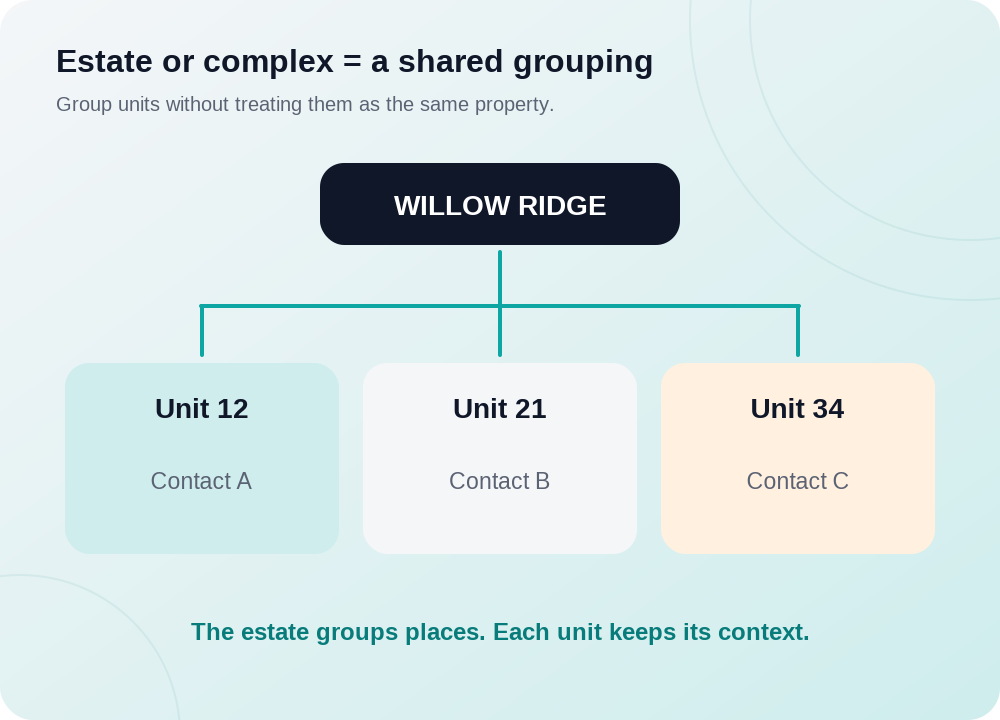
Why are estate and complex used as location labels?
In this glossary, estate refers to a property development rather than a deceased person's estate or everything a person owns. Complex describes a group of connected premises. Estate or complex is therefore an operational grouping label, not the name of one universal legal form.
The phrase's meaning comes from how property professionals use the words in context. A marketing name such as Garden Estate can help identify a neighbourhood development, but its wording cannot tell an agent whether a home is freehold, sectional title or subject to another arrangement.
How should agencies organise estates and complexes?
Create a consistent name for each development and check existing records before adding another spelling. Record the suburb and appropriate address context. Then associate the correct unit and people with that location. This prevents one development appearing as several separate places because one spreadsheet used an abbreviation.
Plan work around useful local information: which unit the conversation concerns, which agent covers the development and what follow-up is due. If an agent learns a new access procedure or managing contact, record it in the appropriate place and verify it before colleagues rely on it.
- Use one agreed development name with recognised alternative names where needed.
- Keep suburb and unit references distinct.
- Check ownership and occupation relationships independently.
- Verify scheme rules and access instructions with the appropriate source.
A complex name does not establish its legal structure
The Community Schemes Ombud Service describes community schemes broadly, including sectional title developments, homeowners' associations and other arrangements involving shared use and responsibility. This is wider than any single everyday label such as complex.
An agency should therefore check the actual scheme documents and property records before explaining rights, levies or governance to a client. Do not assume that every estate is a homeowners' association or every complex is sectional title. The place name is useful for organisation; the applicable documents establish the relevant structure.
How location grouping improves everyday property work
Location grouping helps an agent prepare for calls, viewings and local follow-ups without rebuilding a list each time. It also makes inconsistencies visible: a unit assigned to the wrong suburb, a duplicated development or an owner linked to the wrong address can be found before the next conversation.
The relationship should still be checked at unit level. A development's managing agent is not necessarily the landlord of every home, and an occupier is not necessarily the owner. Keep each person's role clear so that requests and updates reach the right party.
Estate and suburb organisation in EasyPropCRM
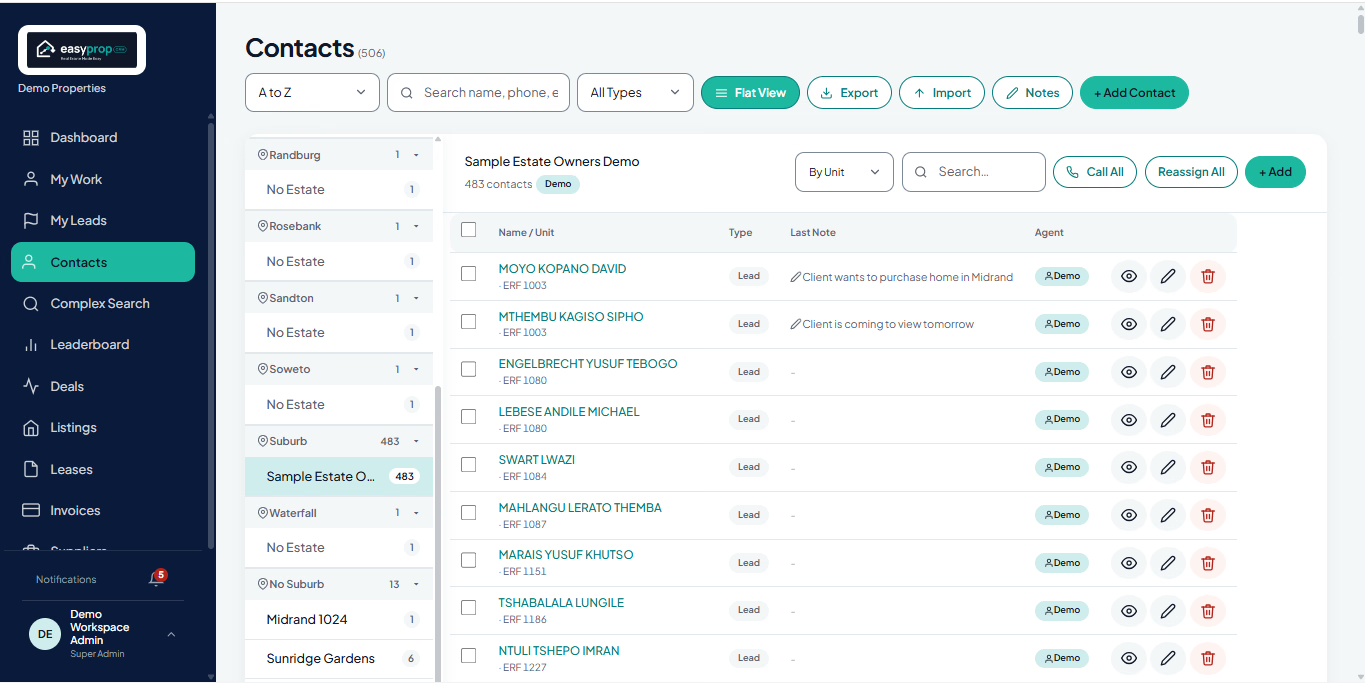
EasyPropCRM includes estate and suburb views so agents can organise property contacts by location and work a development unit by unit. Contact records, assigned responsibilities and follow-ups add the detail needed to move from a location list to a useful conversation.
To evaluate the workflow, bring a development with several units and different owner and occupier relationships. Check how an agent finds a particular unit, records the conversation and moves to the next relevant contact. This is more useful than testing with a list in which every property has the same person and role.
Location labels and legal descriptions
| Term | Working meaning | What to verify separately |
|---|---|---|
| Suburb | Wider local area | Correct municipal and address context |
| Estate or complex | Named development | Scheme and ownership arrangements |
| Unit | Individual home or premises | Exact unit or section reference |
| Erf | Land parcel | Complete official property description |
Further reading on estate or complex
Explore the references and related guidance behind this term.

Estate or complex FAQs
Short answers to the questions that come up after the main details.
Explore the help centreIs an estate the same as a suburb?+
No. A suburb is a broader location. A named estate or complex is usually a development within an area, though address conventions can vary.
Does every complex use sectional title?+
Do not infer ownership structure from the word complex. Check the relevant property and scheme documents.
Should unit numbers include the complex name?+
Keep enough context to identify the unit unambiguously. Unit 12 alone is rarely sufficient across an agency's whole portfolio.
Can an agency work a development without managing it?+
Yes. An agency may have contacts or listings there without being the scheme's managing agent. Record that distinction clearly.
Ready to see your property workflow?
One subscription for deals, billing, admin and portal syndication. See how EasyPropCRM fits your agency with a focused demo.