 Log in
What is a deal stage?
A deal stage is a short label showing where a sales or rental opportunity sits in the agency's process. It helps the team see what has happened and what must happen next. A useful stage is supported by a clear event, such as an offer received or an agreement signed.
What does a deal stage tell a property agency?
A pipeline contains opportunities at different levels of progress. A new enquiry, a negotiated offer and a signed lease should not be treated as equally advanced. Deal stages give the agency a shared vocabulary for these differences, making it easier to decide where attention is needed.
The stage should describe the opportunity rather than the mood of the agent. Interested can mean very different things to different people. Viewing completed is more specific, although it still needs a recorded outcome and next action to be useful in a weekly pipeline discussion.
Meaning · word origin · property examples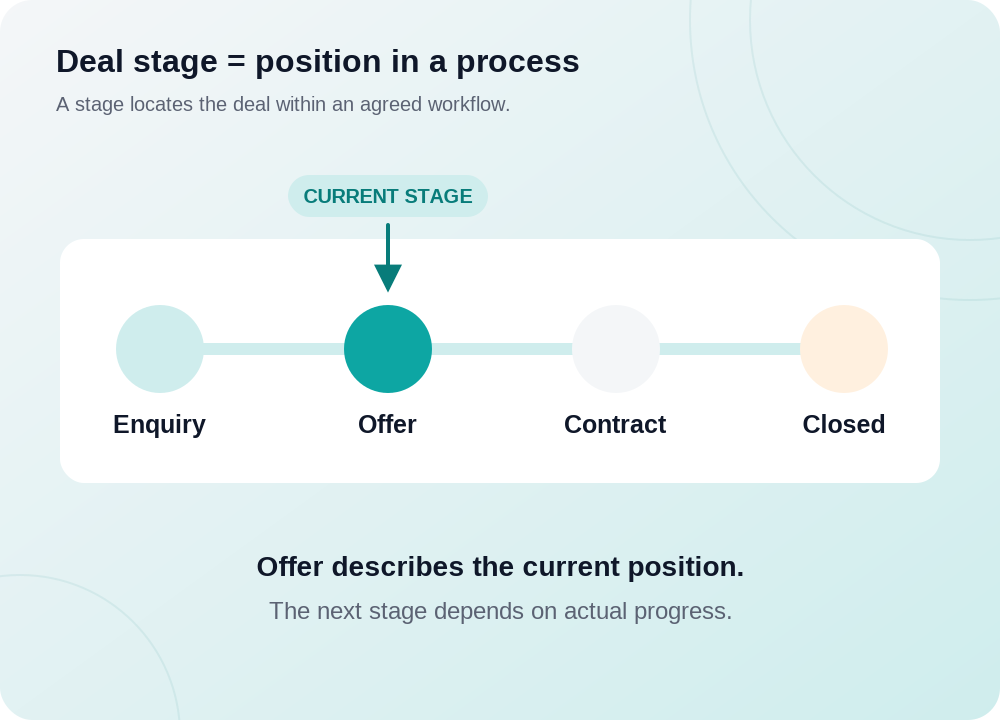
Why is it called a deal stage?
Deal stage is a compound business expression. Deal identifies the opportunity or transaction being worked on; stage identifies one part of its progression. Pipeline is the related visual metaphor for several opportunities moving through a sequence. These descriptions do not imply that every property transaction follows an identical path.
In a CRM, stages turn that everyday language into a consistent set of working labels. Agencies should explain their own labels to new staff, because terms such as agreed, contracted and closed can carry different operational meanings in different teams.
How should property pipeline stages be designed?
Choose stages that correspond to meaningful changes in the work. For each one, define what evidence is needed to enter it, who owns the next task and what would move the opportunity forward. Separate sales and rental thinking where their milestones differ, rather than forcing every transaction into language that fits only one service.
Keep the sequence readable. An excessive number of nearly identical stages can make agents hesitate or choose inconsistently. If a detail is better expressed as a dated task, condition or note, record it there instead of creating another pipeline stage.
- Define entry criteria for every active stage.
- Record the next action and its responsible agent.
- Review opportunities that have stopped progressing.
- Record why an opportunity was lost or withdrawn.
Why closed does not necessarily mean paid
A pipeline outcome and a financial event answer different questions. Closed may mean that the agency regards its deal work as complete, but commission may still depend on contractual conditions and payment processing. A signed agreement, transfer milestone, invoice issue and bank receipt should not be collapsed into one ambiguous label.
Stages also differ from probabilities. Calling a deal negotiation does not prove a particular chance of completion. If the agency uses forecasts, it should explain the assumptions and review them against real outcomes instead of treating stage labels as guaranteed future revenue.
How do you keep a property pipeline trustworthy?
A useful review asks for evidence: the date of the last client response, the outstanding condition and the next step. Correct a stage when circumstances change. Moving an opportunity backwards can be more accurate than leaving it in an advanced column after a buyer's circumstances have changed.
Keep the financial basis clear as well. Sale value, expected commission and received income are different measures. A report should identify which amount it is showing. This avoids presenting a large sales pipeline as if the agency already had that amount available to spend.
How deal stages work with EasyPropCRM
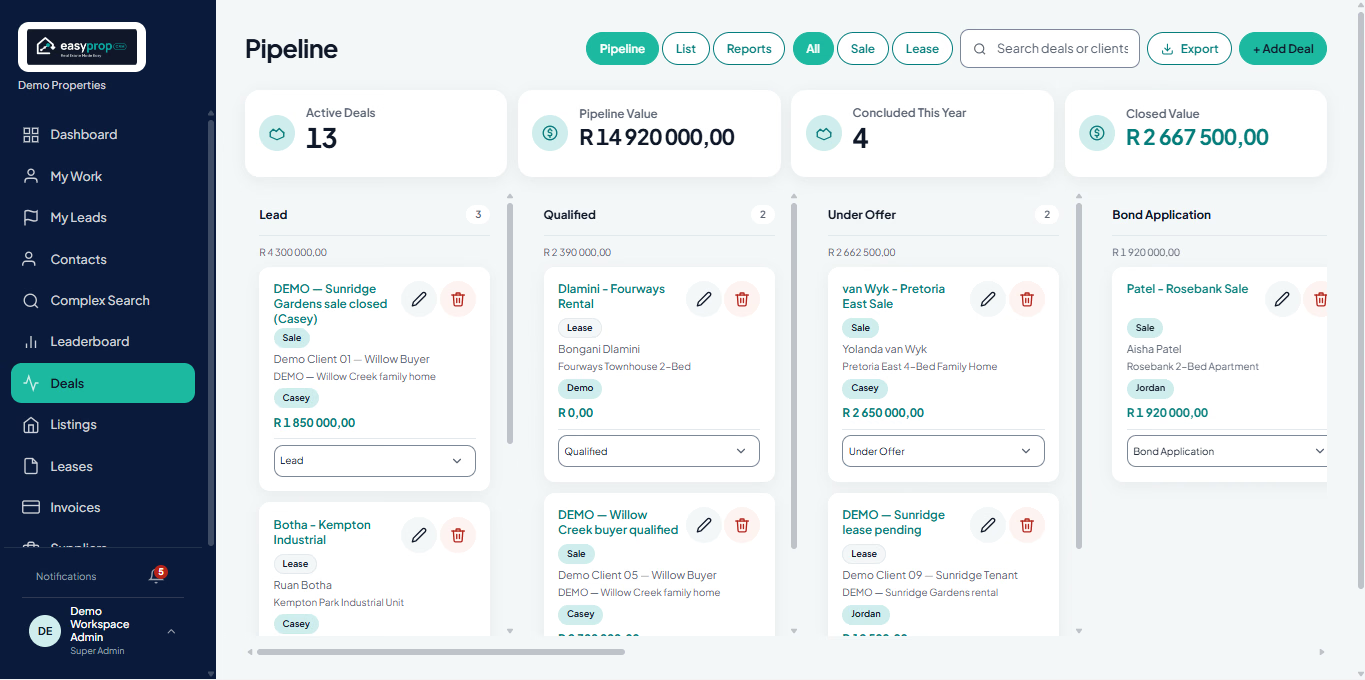
EasyPropCRM supports configurable pipeline stages for sales and leases, with commission calculations and reporting alongside the deal work. The purpose is to let an agency use a process its team understands while keeping contact and transaction information connected.
During setup, map the agency's actual process using one sale and one rental. Include an opportunity that fails, one that stalls and one that completes. Review the dashboard and reports after moving those examples through the stages so that everyone understands what each result represents.
Pipeline events and financial events
| Event | What it establishes | What still needs checking |
|---|---|---|
| Viewing completed | A viewing took place | Client response and next action |
| Agreement signed | Relevant parties have signed | Conditions and required next steps |
| Deal marked closed | Agency's chosen outcome is recorded | Meaning of closed in its process |
| Payment received | Funds have arrived | Correct allocation and accounting treatment |
Further reading on deal stage
Explore the references and related guidance behind this term.

Deal stage FAQs
Short answers to the questions that come up after the main details.
Explore the help centreHow many deal stages should an agency use?+
Use enough to distinguish meaningful work and decisions. There is no universal correct count; stages should be easy for the team to apply consistently.
Can a deal move backwards?+
Yes. If the facts change, the recorded stage should change with them. Add context so colleagues understand the reason.
Should lost deals be deleted?+
An agency can retain an appropriate outcome record under its retention policy. Understanding why opportunities were lost can improve follow-up and qualification.
Is a viewing a deal stage or a task?+
It can be either, depending on the process. Use a stage for a meaningful state and a task for the specific appointment or action required.
Ready to see your property workflow?
One subscription for deals, billing, admin and portal syndication. See how EasyPropCRM fits your agency with a focused demo.